EOD

EOD

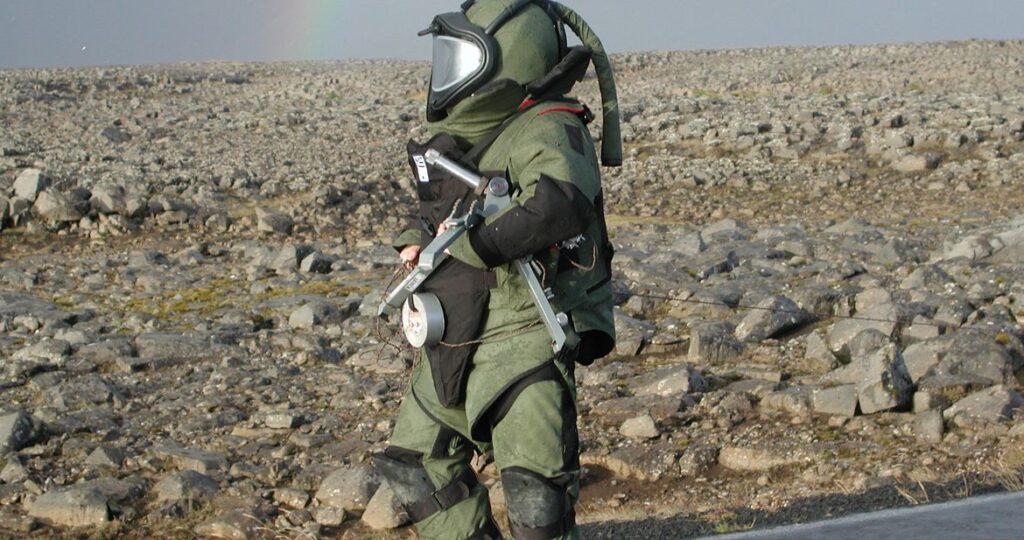
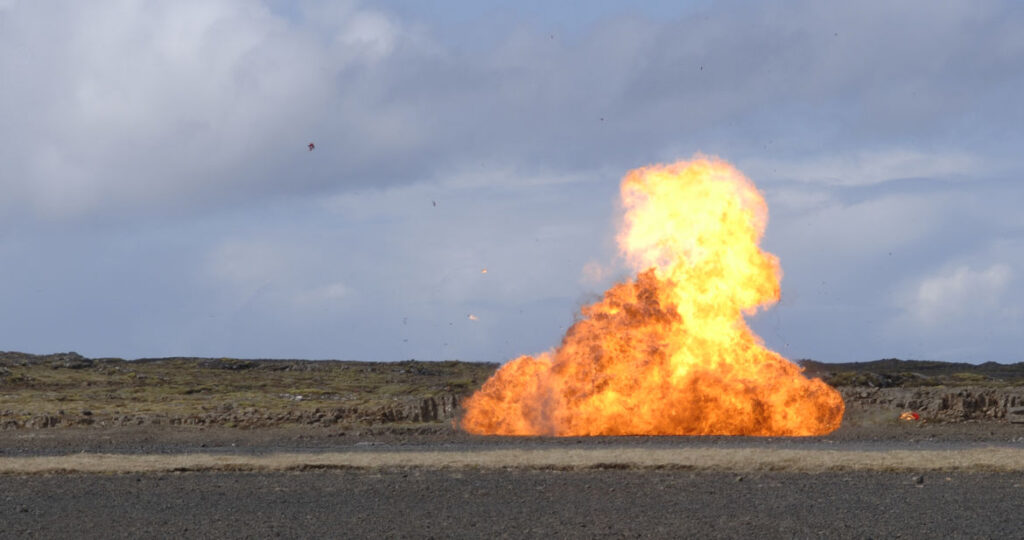
The role of the ICG bomb disposal unit/EOD is to locate and destroy hazardous explosive items both on land and at sea.

The ICG Bomb Disposal Unit personnel is trained and operates according to NATO standards and is highly experienced. The unit’s equipment is also highly specialised and includes remotely operated vehicles (robots), which can be used in a variety of roles in bomb disposal operations, and two specially equipped trucks, which are used to transport the robots and other necessary equipment between locations.


Brief Introduction to the

Explosive Ordnance Disposal Unit

The former Vogaheiði Artillery Range covers and area of approximately 15 km² in the southwest of Iceland. The range was in use from1952 until1959 by the Iceland Defence Force. The pictures on the sign are of items likely to be located on the area in the condition they are found today.

Introduction

Explosive Ordnance Disposal (EOD) has been a national necessity in Iceland since 1940, after the islands occupation by allied forces on May 10 of that year. During the war hostilities did not take place between opposing forces on the Icelandic mainland, although a number of opportunist attacks were made by long range aircraft on both military and civilian targets by the German Luftwaffe. At sea however, there was a great deal of confrontation between allied and axis navies and air forces, as a result of which many Icelandic seaman and civilians lost their lives.

Today the Icelandic Coast Guard (ICG) EOD Unit has many diverse ammunition and explosives related tasks to perform as the responsible government agency in this area of expertise.  Bomb Disposal has evolved considerably since WW II, although the basis for employing EOD Technicians in peacetime remains more or less the same regarding the saving of lives, prevention of injury and damage, and the removal or reduction of the risk from unexploded and dangerous explosive items, where there is a threat to the general public.

This article gives a brief description of the history of EOD in Iceland from WW II up until the present and describes some of the tasks currently performed by the Icelandic Coast Guard EOD Unit.

WW II

During the occupation of Iceland, which lasted until the end of the war, military forces from Britain, Canada and America were stationed on the island, and at one point the country hosted a joint forces garrison of over 50.000 troops.  As a result of the occupation many areas of the countryside were used for military training and manoeuvring, the sparseness of the population and landscape lending itself to the establishment of firing ranges and exercise areas for all types of weaponry and military manoeuvres. 


US Troops training with a British 25 pounder Gun. 

 When the troops embarked from Iceland after the war, and with them the engineers trained and equipped to clear firing ranges and exercise areas of unexploded shells and ammunition (UXO), it became apparent that some indigenous EOD countermeasures would be required to deal with the problem of the remaining UXO, both on land and in the sea.  UXO has in fact been found in almost every location where troops were stationed in Iceland and the search for and destruction of UXO forms a major part of ICG EOD work today, especially in those areas likely to be frequented by the public.

At sea during WW II the Battle of the Atlantic raged around Iceland’s shores and the islands many deep fjords were used as safe anchorages for both allied warships and for merchant vessel convoys forming up prior to making the hazardous voyage to northern Russia with precious aid and war materials. 

In an attempt to reduce the threat from enemy U-boats and surface vessels the Royal Navy mounted Operation “SN”, which was in essence an attempt, by mining, to prevent the enemy from breaking out into the Atlantic Ocean through the Orkney - Faeroes - Iceland Gap and through the Denmark Straight from the North into areas where trans-Atlantic shipping and allied warships could be attacked.  The operation lasted for 3 years during which time over 110,000 buoyant mines of various types were laid by a specially formed Royal Navy task force.

From the very outset of Operation “SN”, drifting and stranded mines were a threat to the Icelandic fishing fleet and the population living in coastal areas.  Although comprehensive navigation warnings were given, accidents occurred and several Icelandic and other friendly vessels were sunk. 

The Coast Guard played its part in dealing with many of the drifting mines, mainly by sinking with gunfire, whereas on land Icelandic volunteers were requested to undergo training in order to render safe and destroy the many stranded mines.  Pétur Sigurðsson, the first Director of the Icelandic Coast Guard attended one of two training courses held in Iceland and thus began EOD operations in the Coast Guard, later becoming part of Coast Guard duties under the Coast Guard Act.  

The first  Icelandic EOD personnel, trained in 1942 by the Royal Navy to neutralise and dispose of sea mines, which at that time were a serious problem due to stranding.  Furthest to the right is Pétur Sigurðsson the first Director of the Icelandic Coast Guard.

During the period of allied logistic support to Russian Forces, escorted merchant convoys left from Iceland to ports such as Murmansk.  In an effort to hinder these operations German U-Boats laid mines off Iceland’s Western and Eastern Fjords in areas where the convoys would most likely form up.  The German mining effort was however, not sustained and was therefore largely ineffective.

The major fjords, where allied shipping found shelter for refuelling and repairs were defensively mined with shore controlled mine barriers.  After the war the barriers were removed although clearance operations were not entirely successful and a number of mines still remain today.

 At the close of WW II sea mines remained a problem and still are, albeit to a lesser extent today.  The Icelandic Coast Guard Unit currently deals with an average of five to ten sea mines per year, the majority of which are trawled by the fishing fleet.  On occasion however, mines are located on land, normally after a period of stormy weather or the seasonal movement of sea-ice.  Records show that during and since WW II more than 5000 mines have been either sunk or rendered safe in the Icelandic geographical area.

German magnetic mine on-board Icelandic Trawler.                            

135 kg explosive charge from a UK mine.  

 Many other types of UW Ordnance are recovered by the Icelandic Fishing Fleet and include both UXO items and munitions sea-dumped either during the war or after the occupation of Iceland ended in 1945.  All types of explosive ordnance have been recovered including Aircraft Bombs, Depth Bombs, Depth Charges, Rockets and Gun Ammunition

US 650lb depth bomb.                                                                     UK air-dropped depth charge.  

Note.    For Further information on sea mines and mine- laying including location maps, see the article “Mines and Mine Laying Around Iceland During WW II” on this website in the EOD/Sprengjudeild sector.

The “Cold War”

Post WW II and at outset of the Cold War, US military forces returned to Iceland when the “Iceland Defence Force” was established by mutual consent in 1951.  The purpose of the force being to defend Iceland from the developing threat from the former Soviet Union, Iceland having no military forces of her own.  These forces, which consisted of navy, ground and air forces, established further training and firing ranges predominantly in the south west of Iceland, including air-to-sea firing and bombing ranges off the south and west coasts.

During the Cold War the Icelandic Coast Guard EOD Unit, sometimes in cooperation with US Navy EOD personnel from the NATO base at Keflavík, recovered many items of Soviet and NATO Underwater Ordnance, either stranded or captured in fishing gear.  Due to the tensions of the time and the high level of security applied to all items of ordnance recovered from a possible enemy, many of the Soviet items were later exploited for intelligence purposes.  Occasionally relics from this era are still recovered, although the interest in such items for exploitation has understandably, diminished significantly. 


Hydrophone Array from the cold war era.

 The Iceland Defence Force remains in Iceland, albeit in a much reduced capacity, EOD and Improvised Explosive Device Disposal (IEDD) support is now provided by the Coast Guard to the NATO base under the terms of a Bi-lateral Memorandum of Understanding, the US Navy EOD Unit having been disestablished in 1998.

EOD Today

Nowadays, the understanding and perception of the public regarding the inherent dangers from old ammunition, explosives and explosive devices is far better defined than before and questions and concerns regarding liability and control (risk management) are more likely to be asked than in the past. 

Today’s tasks have broadened somewhat, although dealing with WW II and post-War explosive ordnance remains a large part of the Coast Guard EOD operation, especially with regard to the clearance of former military training areas and firing ranges, where through the purchase of the latest ground compensating metal detectors, it is possible to carry out efficient sub-surface search in the geologically difficult terrain found in Iceland.

Other explosives tasks undertaken by the Unit are the Disposal of Explosives Waste as a contractor to the National Waste Disposal Agency, assistance in Bore Hole Drilling Operations as a contractor to the National Power Company and Explosives/Security Training in both the public and commercial sectors, especially with regard to the international airport and customs services.  The ICG Unit is tasked, on average to two or three calls for explosives assistance per week, ranging from the discovery of UXO and ammunition to the disposal of old and unstable explosives found abandoned in a farmhouse or garage.

Mortar shells etc recovered from a US Training area.

Improvised Explosive Device Disposal (IEDD)

Today, as with more conventional EOD disciplines, no government can afford to neglect this highly specialised Bomb Disposal skill, and the Coast Guards IEDD response to homemade and terrorist bombs, first established in the early 1980’s has evolved dramatically to confront the threats of the modern world. 


HOBO Remote Control Vehicle.

 The Unit supports two operational IEDD vehicles equipped with the HOBO robot system.  with assistance from the Coast Guards helicopter fleet, a rapidly deployable mobile capability for both EOD and IEDD incidents occurring anywhere in Iceland’s economic zone has also been established.

EOD Exercise “Northern Challenge”

EOD Exercise “Northern Challenge” first came into being as a result of joint training co-operation between the ICG EOD Unit and US Navy EOD Mobile Unit Two.  Up until 1998 Mobile Unit Two were the permanent EOD detachment at Keflavík NATO Base and regular defence and EOD exercises were held in Iceland, in which ICG EOD took an active part. 

After 1998 despite Mobile Unit Two leaving the island, cooperation continued, but the joint exercises diminished until in 2002 the Coast Guard organised an EOD/IEDD exercise to coincide with the Iceland hosted NATO Exercise “Cooperative Safeguard”.  Since then the exercise has been held annually, with participation now expanded to include in the 2005* exercise, Denmark Army, Navy and Air force, Norway Navy, Sweden Navy and Army and the UK Army. 

*EOD teams from the US Military and Estonia have also attended the exercise.

 Teams are rigorously tested during the exercise with scenarios made as realistic as possible both on land and underwater.  The standard of the exercise is extremely high and incidents are deliberately challenging, after all, it is far better to make mistakes during training in the world of Bomb Disposal! 

EOD Technician during Exercise Northern Challenge 2004.

The Iceland Crisis Response Unit

In 2003 the Coast Guard were requested by the Foreign Ministry of Iceland, to investigate whether it would be possible to deploy a small EOD Unit to Iraq on behalf of the Iceland Crisis Response Unit (ICRU).  The ICRU had already successfully deployed Medical, Air Traffic Control and Security personnel to the former Yugoslavia and the deployment to Iraq was seen as a further development of Iceland’s support of its allies in post-conflict and peacekeeping operations.

It was eventually decided that a two-man team would deploy to Southern Iraq within the UK lead Multi-National Division – South East Area of Operations.  The Unit was attached to the Danish Battalion at Camp “Eden” North of Al-Basrah just outside the town of Al-Qurnah.  Pre-deployment training and personal kitting was undertaken in Denmark, courtesy of the Danish Army Engineer Regiment, with whom the Coast Guard have had a close working relationship for many years. 


Happy Iraqi children after the Coast Guard EOD Unit had destroyed a number of anti-personnel "bomblets" scattered inside their village.

 The deployment was completed successfully and many lessons were learned for possible future EOD deployments by the Coast Guard Unit.  After the mission it was felt that Iceland could continue to support NATO, UN or other allied post-conflict missions overseas by fulfilling “niche” EOD requirements with regard to EOD and IEDD operations. 

The Future

The Director of the Icelandic Coast Guard is fully committed to maintaining and further developing the Coast Guards EOD response in Iceland as its primary mission under the Coast Guard Act and in the continued support to the Iceland Defence Force.  In addition the support of future ICRU missions by providing trained and equipped Coast Guard EOD personnel is also an exciting prospect for the future.

Whatever the challenge however, the Icelandic Coast Guard EOD Unit is always ready to respond......................

 VIÐ ERUM ALLTAF TIL TAKS!

(WE ARE ALWAYS READY)


Mines and Mine Laying in Iceland WWII


þetta vefsvæði byggir á eplica. eplica vefumsjónarkerfivefumsjónarkerfi - nánari upplýsinga á heimasíðu eplica.